 English
 Español
 عربى
Our Modular GRC System merges installation speed with long-term durability, providing a high-perform...
READ MOREOct 09, 2026
Content
Load class, slot width, material grade and fixing detail decide almost everything about how a channel grate behaves. Get those four in the right order and the rest of the drainage package falls into line.
The short answer is that a grating for a drainage channel is three things at once: a structural component, a hydraulic opening and a walking surface. It only performs if it is specified as all three. Buyers who treat it as a shopping line item, pick a length and pick a finish, usually end up with a cover that rocks under traffic, blocks during the first heavy storm, or fails a site inspection. Buyers who settle the load class, the opening geometry and the material first rarely meet those problems at all.
What follows is the order we work through when a contractor or a municipal engineer sends over a channel detail. It is roughly the order in which mistakes get expensive.
A channel grate is a structural member first. The load class has to be set by the wheels that will actually cross it, not by the average traffic pattern. A delivery van cutting across a pedestrian area once a week is one scenario. A fully loaded truck crossing a yard entrance four times a day is another. EN 124 defines the load classes used across Europe, and most other markets describe grates in the same terms even where their own standard differs.
| Class | Where it usually belongs | What it asks of the grate |
|---|---|---|
| A15 | Footpaths, plazas, cycle routes | Light mesh or frame with almost no wheel load to resist |
| B125 | Residential driveways, parking bays | Moderate strength; must take cars and light vans without flexing |
| C250 | Kerbside channels, kerb inlets | Occasional delivery vehicles; metal grate or heavy-walled resin base |
| D400 | Carriageways, bus lanes, loading bays | Heavy cast iron or thick stainless steel with a rigid support edge |
| E600 | Docks, industrial yards, airport service roads | Extra-heavy design with strict demands on rigidity and anchorage |
| F900 | Aircraft movement and apron areas | Special engineered assemblies, usually with additional concrete encasement |
In reality a grate rarely sees one clean class. A drainage run at the edge of an apron or a dock entrance takes foot traffic, service vehicles and container handling equipment on the same panel. In that situation the specification is written for the heaviest case, with heavier castings, closer support spacing and a deeper section, because replacing an under-rated grate after it collapses costs far more than buying the right one at the start.
Load decides how thick the grate is and how it is supported. The environment decides what it is made of. The shortcut that works most of the time: if the surface is permanently damp and the water carries salt, de-icing agents or process chemicals, specify stainless steel. If it is dry most of the time and carries wheel loads, specify cast iron or a resin-concrete composite.
The hydraulic job of a grate is a trade-off between two forces. Wider slots pass water faster and let coarse debris through. Narrower slots stay cleaner but reduce flow and need more frequent brushing.
Two numbers settle most specifications: slot width and open area. In pedestrian and cycle areas, slots are usually held between 8 and 12 mm so that small wheels cannot drop in. On industrial floors and vehicle crossings, 15 to 30 mm is common where the debris load is coarse rather than fibrous. Open area, meaning the share of the grate surface that water can pass through, is best kept above roughly 30 percent and lowered only where leaf fall or food waste is the dominant problem.
How easily the grate comes out matters more than most specifications admit. A single panel weighing more than about 25 kg will not be lifted by one person, and a grate that is hard to remove is a grate that gets cleaned late. Splitting a long run into panels that a single maintenance worker can handle with a standard hook is one of the cheapest ways to reduce blockage call-outs.
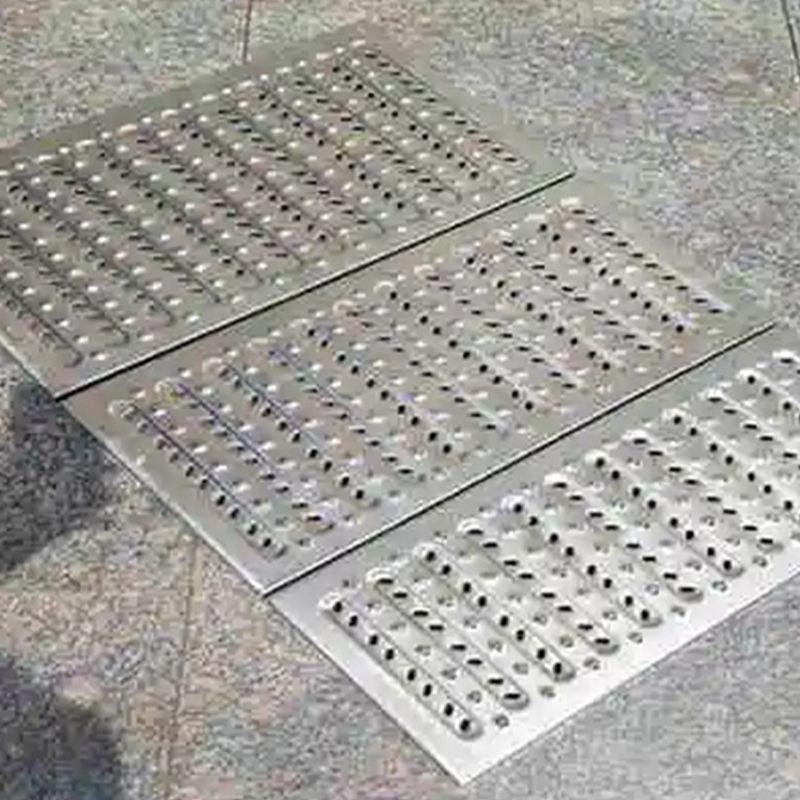
A plain flat grate is smooth, inexpensive and easy to sweep, and it becomes slippery the moment water meets a film of oil. Serrated or stamped surfaces grip far better, particularly on ramps and in wash-down areas. The cost is that brushes catch on the texture and dirt clings to it.
A practical compromise is to split the specification by location rather than by preference. Use a textured or stamped cover where people walk, where vehicles drip, and where a hosepipe is part of the daily routine. Keep the plain finish where the grate is rarely walked on and stays relatively dry. Anti-slip treatment also affects only the top surface, while the bearing bars below it should still be sized by load class alone.
Where the grate has to sit flush with the surrounding paving, as it does in plazas and pedestrian shopping streets, the total available depth becomes very tight and the structural trade-offs have to be settled early rather than after the paving is laid.
Movement is almost never the grate's fault. It comes from the seating. A steel edge frame set on a concrete channel, a gap left after formwork is stripped, a bedding mortar omitted to save a day on site: any of these produces a small amount of give, and a small amount of give grows under daily wheel loads.
A careful step-by-step channel drain installation plan sets out continuous bearing on both sides so the load is spread into the channel body, and that is the part most often simplified into a few welded tags at each end. The result is a grate that still looks correct in the drawings and moves underfoot within a season.
Materials matter here too. On a project that mixes stainless steel in a plaza with cast iron in the carriageway, the two seating systems still have to line up with the same channel body, and a millimetre or two of mismatch is enough to produce a rock. That is one reason to source both from the same drainage channel manufacturer rather than splitting the order between suppliers.
Most grating quotations go backwards and forwards because the enquiry was missing three pieces of information. Put these in the first message and the price you get back is one you can budget against.
If any of those is still open, settle it before the order goes out. Changing a panel length or a load class after the fact usually means a new mould, a new lead time and a fresh freight calculation.
Four decisions, taken in sequence, keep a channel grate out of trouble: load class, material, opening geometry, then fixing and surface detail. Projects that get into difficulty almost always started at the last item and worked backwards.
Then verify one more thing before the panels are made. Measure the channel the grate will actually drop into, rather than the one drawn on the plan. Site dimensions rarely match the drawing exactly, and a small concrete discrepancy turns into a rattling cover or a blocked run a few months later.
Related Products
Our Modular GRC System merges installation speed with long-term durability, providing a high-perform...
READ MOREOur Modular GRC System merges installation speed with long-term durability, providing a high-perform...
READ MOREOur Modular GRC System merges installation speed with long-term durability, providing a high-perform...
READ MOREOur Modular GRC System merges installation speed with long-term durability, providing a high-perform...
READ MOREOur Modular GRC System merges installation speed with long-term durability, providing a high-perform...
READ MOREOur Modular GRC System merges installation speed with long-term durability, providing a high-perform...
READ MORE
Contact us
Factory Address
Group 12, Quanxin Village, Donghai Town, Qidong City, Nantong City, Jiangsu Province, China
phone
+86-13914963840
+86-13451754670
products
QR CODE
 Wholesale Drainage Ditch Manufacturers